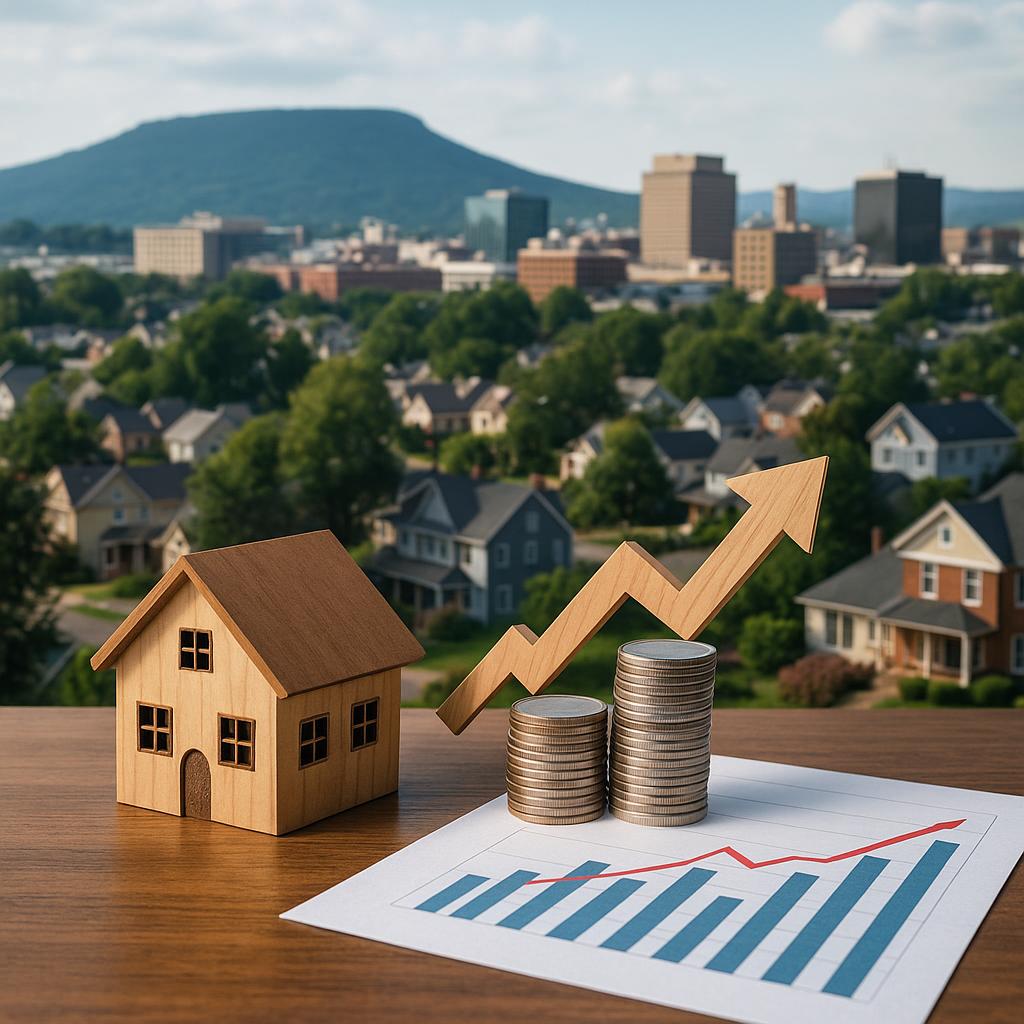
A recent Business Standard report highlights a significant gap between rising home prices and construction costs: residential capital values increased 59% between 2021 and 2025, while construction costs rose 34% during the same period. Although the figures reported in the article are not Chattanooga-specific, the underlying issue is relevant to Chattanooga real estate investing. Rental property owners in Southeast Tennessee must evaluate not only what a property is worth today, but also whether its income, expenses, condition, and long-term operating performance support that value.
For landlords and investors, higher property values can strengthen equity while also making acquisitions more expensive. At the same time, elevated construction and repair costs can affect renovations, insurance decisions, maintenance budgets, and the financial consequences of vacancy or tenant turnover.
Overview of the News
The Business Standard article reports that home prices increased substantially faster than construction costs over the five-year period from 2021 through 2025. Residential capital values rose 59%, compared with a 34% increase in construction costs.
That comparison suggests that property values were influenced by more than the cost of physically building a home. Factors such as land availability, buyer demand, financing conditions, market expectations, and the value of existing housing can all affect property prices. A property does not necessarily become more profitable simply because its market value has increased.
This distinction matters for rental owners. An increase in appraised or market value may improve an owner’s balance sheet, but it can also reduce the yield available to a new buyer. If rents do not rise at a similar pace, an investor purchasing at a higher price may have less room to cover mortgage payments, property taxes, insurance, maintenance, management, and vacancy.
The article does not provide Chattanooga-area rental rates, vacancy figures, or local appreciation data. As a result, the national or international context in the report should not be treated as a direct forecast for Southeast Tennessee. Instead, it is a reminder to separate property valuation from rental-property performance.
What This Means for Chattanooga Rental Property Owners
For existing owners, rising property values may create additional equity. That can affect refinancing decisions, insurance reviews, estate planning, and the evaluation of whether to hold or sell an investment. However, equity is not the same as monthly cash flow. Owners still need to monitor whether rent collection and operating income are keeping pace with the cost of owning the property.
Higher construction costs also have practical consequences. A roof replacement, HVAC failure, plumbing repair, or interior renovation may cost more than it did several years ago, even if the work is relatively routine. Owners who underfund maintenance reserves may be forced to make decisions based on short-term cash availability rather than the property’s long-term needs.
Turnover deserves particular attention. When a tenant moves out, the owner may face lost rent, cleaning, repairs, landscaping, utility costs, leasing work, and possible upgrades before the property is ready for a new resident. A market with higher property values does not eliminate these expenses. In fact, rising material and labor costs can make each turnover more expensive.
Property condition also influences the relationship between value and rental income. A well-maintained property in Northshore may need a different leasing and maintenance strategy than a single-family rental in East Brainerd or Hixson. Location, floor plan, parking, age, amenities, and proximity to employment or services can affect the tenant pool, but owners should verify those assumptions through current property-level information rather than relying only on broad market headlines.
Impact on the Chattanooga Rental Market
The reported increase in residential capital values could affect the Chattanooga rental market indirectly. When purchasing costs rise, some investors may delay acquisitions, seek smaller properties, or place greater emphasis on properties that need limited renovation. Others may consider mid-term rentals or alternative property types, but those strategies carry their own operating requirements and should not be adopted without confirming demand, local rules, furnishing costs, and expected vacancy.
Higher values can also influence existing homeowners who are considering converting a property into a long-term rental. The relevant question is not simply, “What is the home worth?” It is whether realistic rent can support the full cost basis and ongoing expenses. That analysis should include taxes, insurance, utilities paid by the owner, maintenance, capital expenditures, leasing, tenant management, property management, and periods without rent.
Rental demand may vary considerably across Southeast Tennessee. Downtown Chattanooga and nearby areas may appeal to residents seeking proximity to employment, dining, entertainment, and urban amenities, while East Brainerd, Hixson, and surrounding communities may attract tenants looking for different housing characteristics. These differences do not establish a guaranteed rent or vacancy outcome. They do mean that property owners should evaluate each asset according to its actual tenant profile and competitive set.
If home prices rise faster than rents, capitalization rates may compress and cash flow may become more dependent on long-term appreciation. Appreciation is not guaranteed, and it should not be the only justification for an investment. Conversely, if rents and tenant demand support the property’s expenses, a higher acquisition price may still be workable. The answer depends on the individual property, financing, condition, and operating plan.
What Real Estate Investors Should Watch
1. The relationship between price and rent. Investors should compare the proposed purchase price with achievable rent, not with optimistic asking rents or general statements about the Chattanooga market. Use comparable properties with similar locations, size, condition, parking, amenities, and lease terms.
2. Replacement and capital expenditure costs. The construction-cost increase reported in the article reinforces the importance of budgeting for major repairs. A property may appear attractive at acquisition but require substantial capital for roofing, mechanical systems, exterior work, or interior updates.
3. Financing and cash-flow sensitivity. A higher valuation can increase the amount of capital required to purchase a property. Investors should test how the investment performs under different interest rates, repair costs, vacancy periods, and rent assumptions. A deal that works only under ideal conditions may have limited resilience.
4. Tenant quality and lease execution. Rent is only collected when the property is occupied by a tenant who pays according to the lease. Screening, documentation, communication, inspections, and timely maintenance all affect operational risk. These responsibilities are especially important for out-of-area owners who cannot respond quickly to local issues.
5. Local differences within Southeast Tennessee. An investment near Downtown Chattanooga should not automatically be underwritten the same way as one in Hixson, East Brainerd, or a farther-out community. Investors should examine the actual supply of competing rentals, tenant preferences, commute patterns, property taxes, insurance, and maintenance availability for the specific location.
Practical Next Steps for Property Owners
Start with a current property-level review. Estimate achievable market rent using relevant comparable rentals, then subtract recurring operating expenses and a reasonable allowance for vacancy, repairs, turnover, and larger capital items. This produces a more useful picture than looking at gross rent alone.
Next, review the property’s physical condition. Document the age and expected remaining life of major systems, including the roof, HVAC, plumbing, electrical components, appliances, and exterior materials. If construction costs are elevated, preventive maintenance and timely repairs may help reduce the likelihood that a small issue becomes a larger emergency, although no maintenance plan eliminates unexpected expenses.
Owners should also review their leasing and management process. Are inquiries answered promptly? Is rent positioned competitively? Are inspections and work orders documented? Are lease renewals handled before the current lease expires? Is there a clear process for emergencies and after-hours communication? These operational details can influence vacancy, tenant retention, repair costs, and owner workload.
For owners evaluating a purchase or conversion, build more than one scenario. A conservative analysis should include a longer lease-up period, higher repairs, insurance changes, and no assumption of immediate appreciation. For an existing property, compare the expected results of holding, refinancing, renovating, or selling without assuming that past price growth will continue.
If you own rental property in the Chattanooga area and are evaluating whether professional management makes sense for your investment, Capstar Property Management can help you review your current management needs and property goals. Professional rental property management does not remove market or investment risk, but it can provide local support for leasing, tenant communication, maintenance coordination, and ongoing property operations.
For Chattanooga real estate investing, the central lesson from the reported gap between home-price growth and construction-cost growth is that value and profitability are separate questions. Owners who track rental income, vacancy, property condition, expenses, and tenant management can make better decisions about holding and operating an investment in Southeast Tennessee.
- Rising residential values may increase owner equity, but they do not automatically improve rental-property cash flow.
- Higher construction and repair costs make maintenance reserves and capital planning more important.
- Investors should compare realistic rent with the full cost of ownership, including vacancy, turnover, insurance, taxes, repairs, and management.
- Chattanooga-area properties can perform differently by location and asset type, so local property-level analysis is essential.
- Strong tenant management, lease administration, and maintenance processes remain important even when broader property values are rising.
Created by Capstar Property Management AI Assistant.