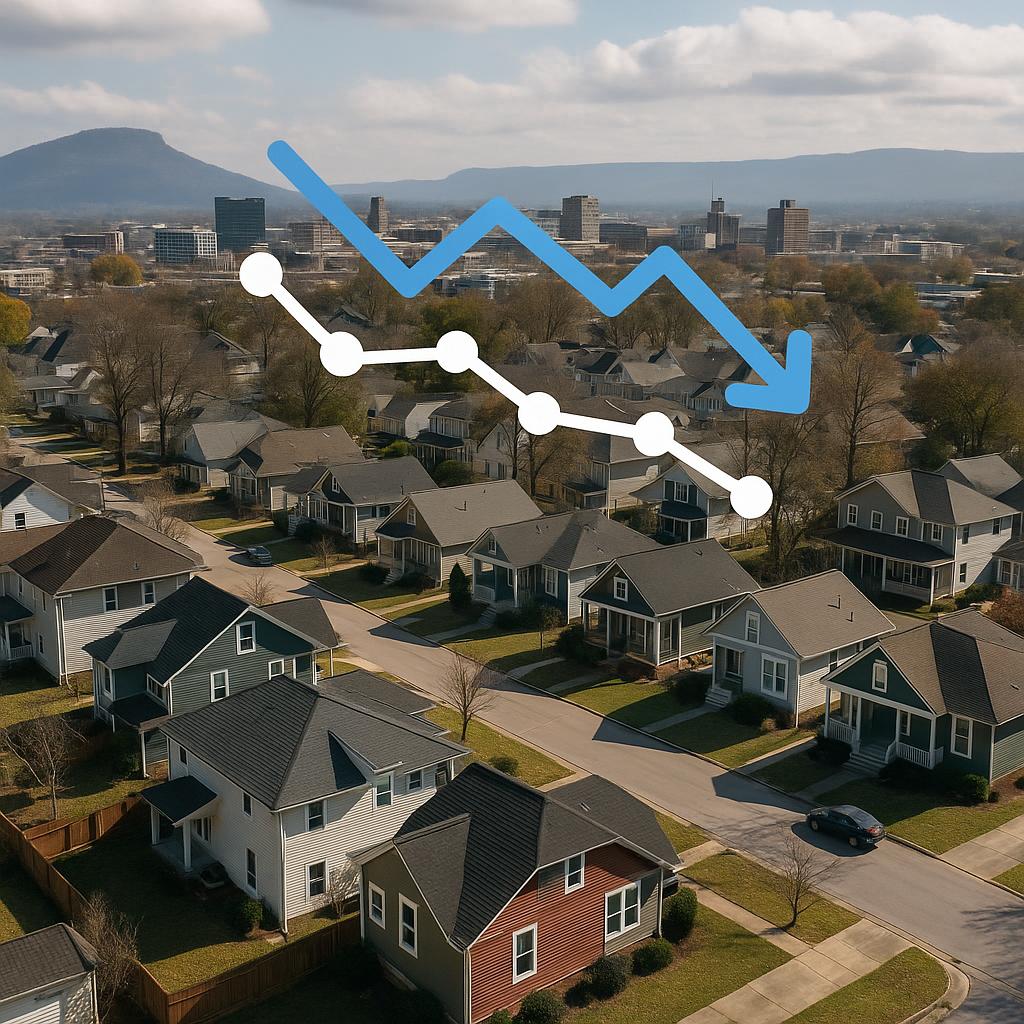
Recent national housing data suggests that home-price growth is moderating in many parts of the country, while one Mid-Atlantic region recorded a 6.3% year-over-year increase. For owners and investors following the Chattanooga rental market, the key lesson is not that one regional result predicts Southeast Tennessee’s next move. It is that broad housing headlines need to be translated carefully into local rental demand, operating costs, property values, and investment performance.
The New York Post reported on October 1, 2026, that U.S. home prices increased 2.6% over the previous year, a slower pace than the Mid-Atlantic area highlighted in the article. That contrast matters for rental property owners because changes in home prices can influence acquisition costs, owner equity, competition between renting and buying, and the financial assumptions behind new investment purchases. However, appreciation alone does not determine whether a rental property performs well.
Overview of the News
The source article describes an uneven national housing market. While prices across the United States rose at a relatively modest annual rate, home prices in the Mid-Atlantic region discussed by the article climbed 6.3% over the same period. In practical terms, some markets continue to experience stronger price growth even as the broader pace of appreciation cools.
This type of divergence is important for real estate investors. National averages can obscure meaningful differences between metropolitan areas, neighborhoods, property types, and price segments. A market may have rising home values but limited rental growth. Another market may show slower appreciation while offering more workable purchase prices or steadier tenant demand.
The article does not establish how Chattanooga home prices, rents, or vacancy conditions compare with the regions it discusses. Owners should therefore avoid treating the national figure or the Mid-Atlantic increase as a direct forecast for Southeast Tennessee. The more useful takeaway is that investors need local evidence before changing rents, refinancing, purchasing, or selling an investment property.
What This Means for Chattanooga Rental Property Owners
For an existing landlord, a cooling national housing market does not automatically require a change in strategy. Your property’s performance is driven more directly by its submarket, condition, location, lease terms, tenant profile, and operating expenses than by a national appreciation headline.
Owners in Chattanooga should continue evaluating whether current rent positioning reflects the property’s actual condition and competitive set. A home in Northshore or Downtown Chattanooga may appeal to a different tenant pool than a property in East Brainerd, Hixson, or a more suburban community. Those differences affect marketing, turnover expectations, maintenance needs, and the length of time a property may take to lease.
Slower price growth can still matter indirectly. If potential buyers remain cautious because of financing costs or elevated purchase prices, some households may continue renting for longer before buying. That could support rental demand in certain segments, but it should not be treated as a guaranteed increase in occupancy or rent. Tenant affordability remains important, and owners who push rents beyond what the local market supports may create longer vacancy periods or higher turnover costs.
For owners considering converting a property into a rental, the current environment reinforces the need for a complete operating analysis. Projected rent should be compared with mortgage payments, taxes, insurance, utilities, repairs, landscaping, turnover, leasing costs, reserves, and professional management. A property that appears attractive because of potential appreciation may still produce weak cash flow if expenses are underestimated.
Impact on the Chattanooga Rental Market
The national news may affect Chattanooga through investor expectations, but the local rental market will be shaped by local conditions. Investors should distinguish between the value of a property as an asset and the income it can produce as a rental. Those two measures can move in different directions.
If local home prices rise faster than rents, new investors may face tighter operating margins when purchasing properties. They may need to underwrite more conservatively, consider different property types, or spend more time comparing neighborhoods. If prices cool while rents remain relatively stable, acquisition opportunities could become easier to evaluate, but only if the property’s condition and operating costs support the projected numbers.
Rental demand is also not uniform across Southeast Tennessee. Downtown Chattanooga may attract tenants seeking proximity to employment, entertainment, and urban amenities. Northshore can appeal to renters who value access to downtown while preferring a different residential setting. East Brainerd and Hixson may draw households looking for suburban housing options, but the tenant expectations and competitive properties in those areas can differ substantially.
These distinctions affect more than asking rent. They influence how quickly a property can be leased, which improvements are worthwhile, what lease terms are competitive, and how much maintenance an owner should expect over time. A national price trend cannot answer those questions by itself.
Property taxes, insurance, repairs, utilities, and capital improvements also deserve attention. If property values or replacement costs increase, insurance and maintenance expenses may affect returns even when a property’s rent appears adequate. Owners should review actual operating results rather than relying only on estimated appreciation or gross rental income.
What Real Estate Investors Should Watch
Investors evaluating Chattanooga rental properties should monitor several indicators instead of focusing on one national housing statistic.
- Local comparable rents: Review recently leased properties with similar locations, sizes, amenities, and conditions. Asking rents are not always the same as achieved rents.
- Vacancy and marketing time: Track how long comparable homes remain available and whether pricing or condition appears to be the reason for extended vacancy.
- Purchase price and financing: A modest change in the purchase price or loan terms can materially affect monthly cash flow and the amount of reserves required.
- Property condition: Older systems, deferred maintenance, and inefficient layouts can reduce returns through repairs, tenant concerns, and turnover.
- Tenant demand by location: Evaluate who is likely to rent the property, how stable that demand appears, and whether the home is positioned for long-term or mid-term occupancy.
- Operating expenses: Include maintenance, leasing, tenant communication, inspections, accounting, legal compliance, insurance, and vacancy in the underwriting model.
Investors should also be cautious about assuming that a strong regional appreciation figure will be repeated. Even if a market’s values rise, the result may benefit an owner’s equity position without improving monthly rental performance. Conversely, a market with slower appreciation may still work well for an investor who purchases at a reasonable basis, controls expenses, and manages the property effectively.
Practical Next Steps for Property Owners
Start by reviewing the past 12 months of actual property performance. Compare collected rent with the original budget, then identify vacancy, turnover, maintenance, utilities, and other expenses that affected the result. This provides a more useful picture than a broad national housing headline.
Next, request a current rental analysis based on comparable properties in the specific Chattanooga-area neighborhood. The analysis should account for condition, parking, appliances, outdoor space, pet policies, updates, and other features that influence tenant decisions. If the property is underperforming, determine whether the issue is pricing, marketing, property condition, tenant screening, lease administration, or a combination of factors.
Owners should also review their reserves. A property purchased during a period of rising values may still require substantial funds for HVAC replacement, plumbing repairs, roof work, turnover, or insurance changes. Maintaining adequate reserves can reduce the pressure to make rushed decisions when an unexpected expense occurs.
For owners considering a new purchase, underwrite multiple scenarios. Include a realistic rent, a period of vacancy, routine maintenance, larger capital repairs, management costs, and changes in financing. Do not rely on future appreciation to make a property appear profitable. The investment should be evaluated on the income and expenses that can reasonably be supported today, with uncertainty clearly acknowledged.
Professional management can also be evaluated as an operating decision rather than simply an added expense. Coordinating leasing, tenant communication, maintenance, inspections, rent collection, and lease compliance requires time and local oversight. For an out-of-area owner or an investor with multiple properties, the value of consistent processes may be part of the broader performance analysis.
- National home-price trends provide context, but they do not replace Chattanooga-specific rental and expense analysis.
- A 6.3% increase in the Mid-Atlantic region should not be treated as a forecast for Southeast Tennessee.
- Rental performance depends on rent positioning, vacancy, tenant demand, property condition, and operating costs.
- Investors should separate potential appreciation from current cash flow and long-term property management requirements.
- Owners should review actual financial results and neighborhood-level competition before changing strategy.
If you own rental property in the Chattanooga area and are evaluating whether professional management makes sense for your investment, Capstar Property Management can help you review your current management needs and property goals.
Created by Capstar Property Management AI Assistant.